


 English
 中文简体
中文简体 Français
 Español
 عربى
عربى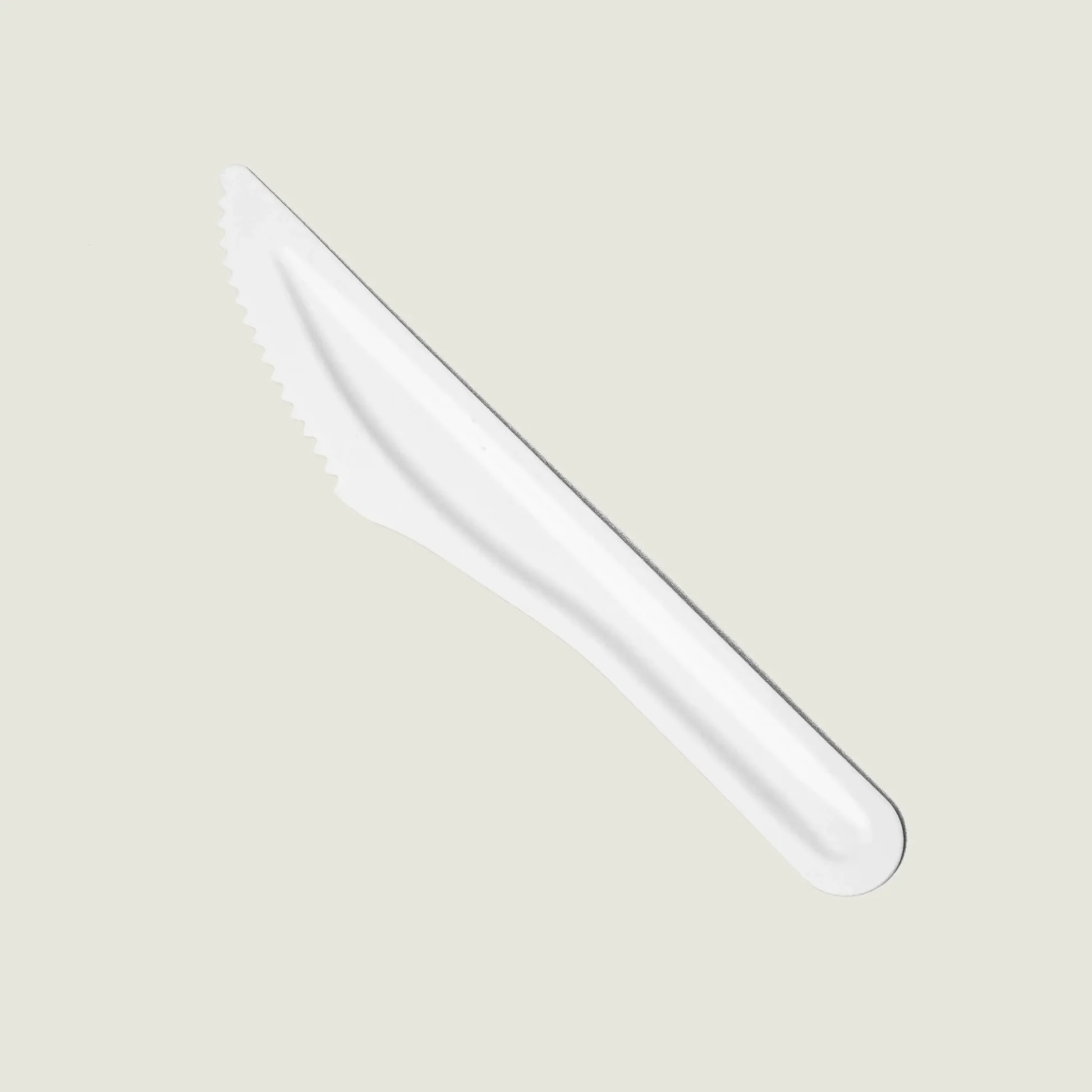



Material Science Behind Disposable Knife Construction: What Determines Cutting Performance
The cutting performance of a disposable knife is determined by a combination of material stiffness, blade geometry, and surface finish — not simply by the material category. Understanding these variables helps procurement teams move beyond generic specifications and select disposable knives that perform reliably with specific food types and service conditions.
Polystyrene vs. Polypropylene Disposable Knives
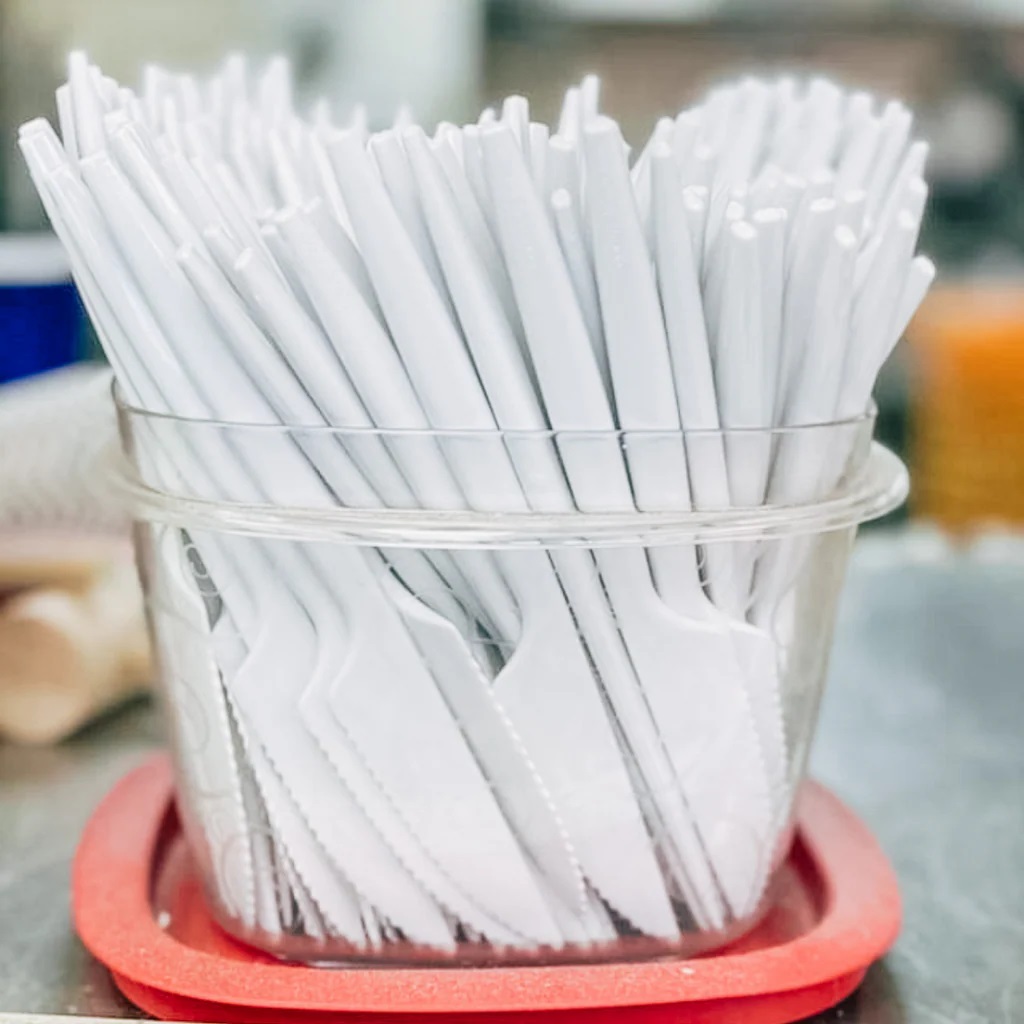
The two dominant plastics used in standard disposable knife production are polystyrene (PS) and polypropylene (PP), and their mechanical properties differ in ways that directly affect cutting performance. PS is stiffer and more brittle — it holds a sharper edge profile and provides less flex during cutting, which translates to cleaner cuts through firm foods such as cooked meats, firm cheeses, and bread crusts. However, PS disposable knives are more susceptible to snapping under lateral stress, particularly when the blade encounters an unexpected hard inclusion in food, such as a bone fragment or a seed. PP is more flexible and impact-resistant, making it less likely to snap, but its lower flexural modulus means the blade deflects slightly under load — reducing cutting precision on tougher foods. For catering operations serving a varied menu, PS disposable knives are generally the higher-performance choice for cutting applications, while PP is better suited to spreading and lighter food handling.
CPLA and PLA Disposable Knives
Crystallized polylactic acid (CPLA) has emerged as the primary eco-friendly material for disposable knives in markets where compostable cutlery is specified. Standard PLA is too brittle and too heat-sensitive for reliable knife performance — it can soften and deform at temperatures above 55–60°C, making it unsuitable for use with hot foods. CPLA, produced by annealing PLA under controlled heat to increase its crystallinity, raises the heat deflection temperature to approximately 85–90°C and significantly improves impact resistance. CPLA disposable knives are noticeably heavier and more rigid than standard PLA, providing a handling experience closer to PS while meeting industrial compostability standards such as EN 13432 and ASTM D6400. The trade-off is cost — CPLA disposable knives typically carry a 40–70% price premium over equivalent PS versions.
Disposable Knife Blade Geometry: Serration Design and Its Functional Implications
The blade geometry of a disposable knife — specifically whether it is smooth-edged or serrated, and the precise form of any serration — has a greater effect on cutting performance than most buyers recognize. Serration patterns on disposable knives are not decorative; they are functional design features that determine how the knife interacts with specific food textures.
A smooth blade edge on a disposable knife relies entirely on edge sharpness and downward pressure to initiate a cut. This works adequately for soft foods — ripe fruits, soft cheeses, cooked fish, and soft bread — where a straight compressive force is sufficient to separate fibers. For foods with a tougher or more elastic surface — cured meats, bread with a hard crust, or fibrous vegetables — a smooth blade requires significantly more pressure and tends to compress and deform the food before cutting begins, producing ragged rather than clean cuts.
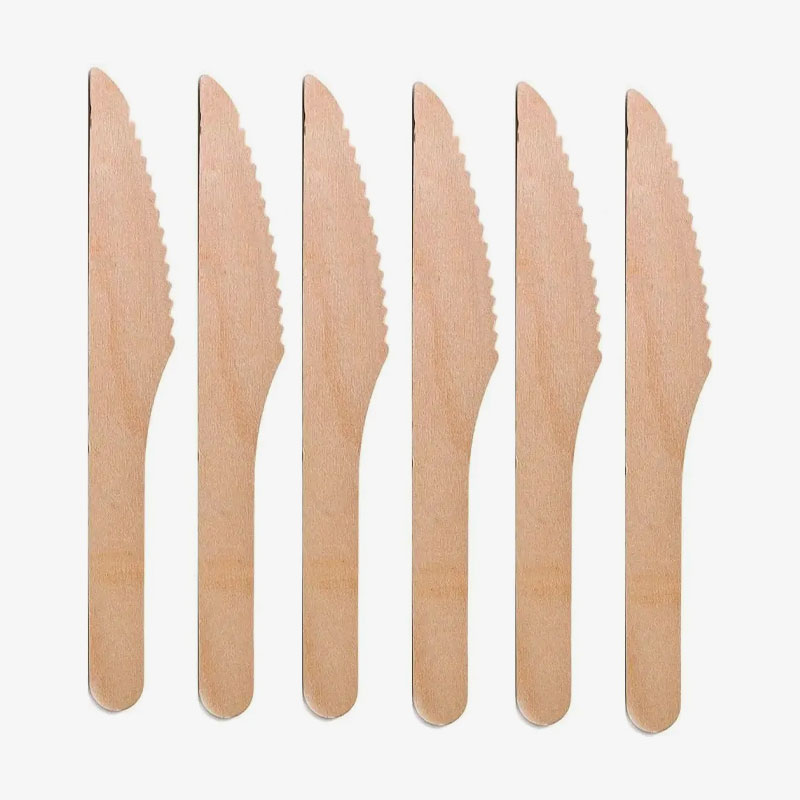
Serrated disposable knives address this through a saw-action cutting mechanism. Each serration point concentrates cutting force on a very small contact area, dramatically increasing local pressure and allowing the blade to initiate penetration of tough surfaces with far less total applied force. The geometry of serrations matters significantly: wider, more widely spaced serrations (macro-serrations) are effective on bread and fibrous foods; finer, more closely spaced serrations (micro-serrations) perform better on smooth-surfaced foods like sausages or cooked poultry where the blade needs to grip a slippery surface before cutting.
| Blade Type | Best For | Limitations |
| Smooth edge | Soft cheeses, ripe fruit, cooked fish, soft bread | Struggles with elastic or tough-surfaced foods |
| Macro-serrated | Crusty bread, fibrous vegetables, cooked meats | Can tear rather than slice smooth-surfaced foods |
| Micro-serrated | Sausages, poultry skin, cured meats, firm fruit | Less effective on very hard crusts or fibrous roots |
| Combination (smooth + serrated zones) | Mixed-texture foods, general deli use | Optimized for neither application; versatile compromise |
Paper-Based Disposable Knives: Construction, Performance Boundaries, and Realistic Use Cases
Paper disposable knives represent the most recent development in the single-use cutlery category, driven by legislative restrictions on conventional plastic cutlery in markets including the EU (Single-Use Plastics Directive, effective 2021), the UK, and several Asian markets. As a company specializing in food-grade paper products — from base paper rolls to die-cut sheets — we have followed this development closely, and it is worth providing an accurate and practical account of where paper disposable knives perform adequately and where they currently fall short.
Paper disposable knives are typically manufactured from multiple layers of compressed paperboard, laminated under pressure and heat to achieve sufficient density and stiffness. The resulting blade has a flexural stiffness lower than PS or CPLA but higher than standard printing paper — the number of plies and the paperboard grade used are the primary determinants of performance. Some constructions incorporate a PE or wax coating on the blade surface to improve moisture resistance and reduce friction against food surfaces, which meaningfully extends the functional service life of the knife in wet food contact scenarios.
The realistic performance envelope for paper disposable knives is narrower than for plastic or CPLA alternatives. They perform adequately for spreading — applying butter, cream cheese, hummus, or jam to bread — and for cutting very soft foods such as cake, ripe banana, or soft tofu. They are not suitable as the primary cutting implement for firm cheeses, cooked meats, fibrous vegetables, or any food requiring sustained lateral cutting force, where the paper blade will flex, delaminate at the tip, or become limp from moisture absorption within minutes. Operators choosing paper disposable knives for regulatory compliance should audit their menu against this performance profile and consider supplementing with CPLA knives for food categories that exceed paper knife capability.