



 English
 中文简体
中文简体 Français
 Español
 عربى
عربى


Single-Wall vs. Double-Wall Kraft Cups: Which One Actually Fits Your Operation?
Choosing between single-wall and double-wall construction isn't just about insulation — it affects cost per unit, hand comfort, and how your brand looks on the counter. Here's how the two compare in real-world foodservice use:
| Feature | Single-Wall | Double-Wall |
|---|---|---|
| Insulation | Moderate — sleeve recommended above 80°C | Strong — air gap keeps hands safe without a sleeve |
| Cost per unit | Lower | 15–25% higher, but eliminates sleeve spend |
| Print surface | Smooth outer wall — excellent for large branding areas | Slightly textured from inner wrap — still fully printable |
| Best for | Cold brew, iced drinks, moderate-temp hot drinks | Espresso-based drinks, soup, high-volume hot takeaway |
For high-turnover coffee counters where latte orders dominate, double-wall eliminates a touchpoint and speeds up service. For cold-drink focused menus or budget-sensitive catering runs, single-wall with a branded sleeve can actually deliver stronger visual impact at lower unit cost.
What "Food-Grade Kraft Paperboard" Really Means for Hot Beverage Safety
The term "food-grade" covers a specific set of material and coating requirements that directly affect whether a cup is safe for hot liquids. Understanding these specs helps buyers avoid sourcing cups that fail during use:
- PE (polyethylene) inner coating: A thin food-safe PE film lines the interior wall, creating a moisture barrier that prevents the paperboard from absorbing liquid, which would cause structural failure and leakage. Standard PE coating weight for hot cups is 18–20 g/m².
- Temperature rating: Certified kraft cups are engineered to hold beverages up to 100°C continuously without seam failure. Inferior cups often delaminate at the side seam between 70–80°C.
- Migration compliance: Food-grade paperboard must meet migration limits for substances like fluorochemicals and mineral oils. Look for compliance with FDA 21 CFR, EU 10/2011, or equivalent standards.
- Grammage of base paper: Hot cups typically require 170–350 gsm paperboard depending on cup size. Thinner stock saves cost but reduces rigidity and can cause hand deformation when gripped.
At Hangzhou Renmin Eco-tech Co., Ltd., our Kraft Coffee Paper Cups are manufactured using certified food-grade kraft paperboard with full compliance to international safety standards — backed by our ISO9001:2008 and ISO14001:2004 certifications.
The Recyclability Gap: Why Not All Kraft Cups Are Actually Recyclable
Kraft paper cups are widely marketed as eco-friendly, but recyclability depends heavily on infrastructure and coating type — and many buyers conflate "looks natural" with "fully recyclable." Here's what determines actual end-of-life outcomes:
The PE coating problem: Standard kraft cups use a PE inner lining that requires specialist paper mills with hydrapulping capability to separate the plastic from the fiber. In markets without this infrastructure — including many parts of Southeast Asia and Africa — these cups end up in landfill despite being labeled recyclable. Only about 1 in 400 paper cups gets recycled in the UK, according to waste sector estimates, largely due to this collection and processing gap.
PLA-coated alternatives: Some manufacturers offer PLA (polylactic acid) coated cups, marketed as compostable. However, PLA requires industrial composting conditions (58°C+ sustained heat) and is not compatible with standard paper recycling streams. Mixing PLA cups into paper recycling can actually contaminate a batch.
Aqueous/water-based coating: The most genuinely recyclable option uses a water-based barrier coating that integrates with the paper fiber and can be processed by conventional paper mills. This is an emerging standard in the EU market and worth specifying explicitly when sourcing for sustainability-focused clients.
When specifying Kraft Coffee Paper Cups for a market with active recycling infrastructure, always confirm the coating type and whether the cup is certified under recognized schemes like the Forest Stewardship Council (FSC) or Seedling compostability mark.
Sizing Standards and Volume Tolerances in Commercial Cup Sourcing
Cup sizing is not globally standardized, and mismatches between cup nominal size and actual fill volume are one of the most common sourcing pain points for importers and café operators. Key conventions to understand:
- Nominal vs. fill volume: A "12 oz" cup has a nominal capacity of ~355 ml but a recommended fill volume of 300–320 ml to allow for a lid recess and headspace. Ordering based on nominal size without confirming fill volume leads to underfilled drinks or overflow.
- Lid compatibility: Cup diameter at the rim must match the lid diameter precisely — standard sizes include 62mm (small espresso), 80mm (8–12 oz range), and 90mm (16–24 oz range). A ±1mm tolerance error causes lid pop-off or liquid escape during commuting.
- Common foodservice sizes: 4 oz (espresso/sample), 8 oz (small), 12 oz (medium), 16 oz (large), 20–24 oz (extra-large for North American markets). European markets skew toward 6–12 oz for hot coffee.
- Stacking height: For high-volume venues using cup dispensers, the stacking pitch (how much each cup protrudes above the one below) affects dispenser compatibility. Specify stacking height per 50-cup stack when ordering for automated dispensing systems.
Custom Printing on Kraft Cups: Practical Limits and What Actually Works
The natural brown surface of kraft paperboard creates a distinctive substrate for branding — but it behaves differently from white cups, and those differences affect design outcomes significantly.
Color Rendering on Unbleached Kraft
The warm brown base absorbs light colors differently than white board. Yellow, orange, and red inks print vibrantly on kraft and gain a earthy, artisan quality. White ink requires an opaque base coat and a separate print pass, adding cost — but it's often necessary for logos with fine detail or light-colored text. Blues and greens can appear muted or shifted slightly warm; always request a physical proof before approving a full production run.
Minimum Order Quantities and Print Setup
Flexographic printing — the standard for kraft cup production — requires plate creation per color per size, with setup costs typically amortized over a minimum of 10,000–50,000 units per SKU. For smaller runs, digital printing on pre-formed cups offers lower MOQs (sometimes 500–1,000 units) at a higher per-unit cost. Brands launching limited editions or seasonal designs increasingly use digital printing for short runs while maintaining flexo for core SKUs.
Wrap Coverage and Bleed Zones
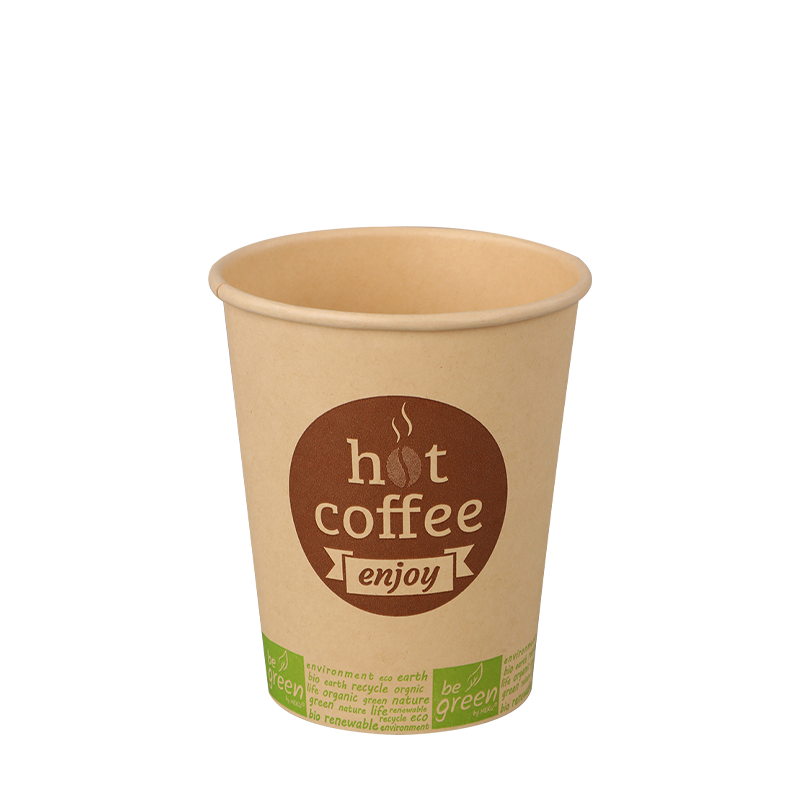
Kraft cup templates are fan-shaped (tapered trapezoids), not rectangular. Designs must be adapted to this fan shape to avoid distortion after forming. A standard 12 oz cup has a print wrap of approximately 270°–300°, leaving a small overlap seam zone that should be kept clear of key design elements. Bottom and top margins of around 8–12mm are typically unprinted to accommodate seaming.
As an OEM/ODM manufacturer, Hangzhou Renmin Eco-tech Co., Ltd. supports full custom artwork on our Kraft Coffee Paper Cups, with in-house design review to ensure your print files are optimized for the kraft substrate before plates are cut.
Storage, Shelf Life, and Humidity Sensitivity in Kraft Cup Inventory Management
Paper cups are moisture-sensitive, and improper storage is one of the most overlooked causes of cup failure in the field. Kraft cups that have absorbed ambient humidity during storage can develop weak seams, irregular rim geometry, or ink smearing — none of which are detectable until the cup is in service.
- Recommended storage conditions: 15–25°C, relative humidity below 65%. Pallets should be stored off the floor on racking, away from external walls in humid climates.
- Shelf life: Properly stored kraft cups have a practical shelf life of 18–24 months from manufacture date. Beyond this, PE coatings can micro-crack, and paper strength degrades measurably.
- Packaging integrity on arrival: Cups are typically sleeved in plastic film per stack and boxed. Inspect for punctured sleeve film on receipt — even small punctures in humid port environments (e.g., Southeast Asian transshipment hubs) can allow enough moisture uptake to affect rim integrity.
- FIFO rotation: For high-volume buyers receiving regular container shipments, strict first-in-first-out rotation prevents older stock from sitting past shelf life while newer stock is used first.