

-
Products


-
Food Packaging Solution
Mission & PhilosophyRenmin Eco-Tech adheres to the philosophy of green, innovation, and responsibility, placing customers at the center and valuing dedicated professionals. We aim to integrate sustainability and eco-consciousness into every product.
 Green Innovation Leading the Future
 -
Our Story
Why Choose Us?Hangzhou Renmin Eco-tech Co., Ltd, situated in the picturesque city of Hangzhou, Zhejiang, is a leading paper product research, development, and sales company. Established in 2004, we specialize in eco-friendly solutions such as Base Paper Rolls, PE Coated Paper Rolls, Paper Cup Fans, Paper Bowl and Box Fans, Die-cut Sheets, etc, for food packaging, and Aluminum Foil Film laminated paper.
 Coming From China, Marketing To The World.
 -
News
 Aluminum Foil Paper Bowls: Structure, Performance & Foodservice Applications
What Aluminum Foil Paper Bowls Actually Are — And Why the Laminate Structure Matters Aluminum foil paper bowls are composite containers built from two bonded materials: a structural paperboard base t...
 English
 中文简体
中文简体 Français
 Español
 عربى
عربىIndustry News
Aluminum Foil Paper Bowls: Structure, Performance & Foodservice Applications
Content
- 1 What Aluminum Foil Paper Bowls Actually Are — And Why the Laminate Structure Matters
- 2 Core Performance Advantages Over Standard Paper and Plastic Containers
- 3 Primary Use Cases: Where Aluminum Foil Paper Bowls Outperform Alternatives
- 4 Foil Thickness and Laminate Specification: What Buyers Should Specify
- 5 Recyclability of Aluminum Foil Paper Bowls: The Composite Material Challenge
- 6 Custom Printing and Branding on Aluminum Foil Paper Bowls
What Aluminum Foil Paper Bowls Actually Are — And Why the Laminate Structure Matters
Aluminum foil paper bowls are composite containers built from two bonded materials: a structural paperboard base that provides rigidity and handleability, and a thin aluminum foil layer — typically 7–30 µm in thickness — laminated to the interior surface. This combination delivers a container that neither material could achieve alone. Paperboard without foil lacks the barrier performance required for oily, acidic, or moisture-heavy food contents; aluminum foil without the paper substrate lacks the structural strength and thermal insulation needed for practical foodservice use.
The lamination process fuses the two layers under heat and pressure, creating a unified material where the foil acts as a complete barrier against oxygen, moisture, light, and volatile aroma compounds. Research published in Food Reviews International confirms that aluminum foil's barrier function against moisture, oxygen, and other gas migration is generally superior to any plastic laminate material — a performance advantage that explains its continued dominance in premium food packaging despite the availability of cheaper alternatives.
For foodservice operators, the practical implication is a bowl that maintains food quality across a wider range of conditions — hot holding, cold storage, transport, and reheating — without the performance degradation that affects single-material containers in each of those environments.
Core Performance Advantages Over Standard Paper and Plastic Containers
The performance gap between aluminum foil paper bowls and conventional single-material containers is most visible across four dimensions that directly affect food quality and operational reliability:
Complete Barrier Protection
Standard PE-lined paper bowls resist moisture but allow oxygen transmission at measurable rates. Aluminum foil provides a complete barrier to light, oxygen, moisture, and bacteria — a total barrier that plastic laminates cannot match at equivalent film thickness. For food contents sensitive to oxidation — roasted meats, fatty sauces, grain bowls with avocado or nut toppings — this difference in oxygen transmission rate translates directly into longer hold-time quality and reduced food waste.
Thermal Versatility
Aluminum foil paper bowls can move from freezer storage (−18 °C) through refrigerated holding (2–5 °C) into conventional oven reheating (up to 200 °C) without structural failure. Aluminum reflects up to 98% of infrared heat, which improves oven heating efficiency and helps maintain even temperature distribution across the food contents. Standard paper containers cannot be used in conventional ovens, and plastic containers are limited to microwave-safe applications at moderate temperatures — making aluminum foil paper bowls the only disposable format that covers the full thermal range from freezer to oven.
Oil and Acid Resistance
The aluminum foil interior creates a non-absorbent, chemically inert contact surface for most food types. Unlike PE-lined paper bowls where the coating's oil resistance is determined by coating weight and formulation, the foil layer presents a uniform, pinhole-free surface that does not absorb oils, fatty acids, or water-based liquids regardless of hold time. The primary exception is direct contact with highly acidic or salty foods, which can cause aluminum ion dissolution — a risk managed by applying a food-safe lacquer or PE overcoat on the foil interior for applications involving vinegar-dressed salads, citrus-based sauces, or fermented foods.
Shape Retention Under Load
The foil laminate adds meaningful stiffness to the paperboard substrate, increasing resistance to sidewall buckling and base deformation under the weight of dense food contents. For delivery applications where filled bowls are stacked or subjected to lateral movement in insulated bags, this structural contribution reduces collapse-related spill incidents that generate customer complaints and product loss.
Primary Use Cases: Where Aluminum Foil Paper Bowls Outperform Alternatives
Aluminum foil paper bowls are not a universal replacement for all food container formats, but in specific use scenarios they deliver advantages that justify their higher unit cost over standard paper or plastic alternatives.
Airline and Institutional Catering
Airline food packaging has relied on aluminum foil containers for decades, a preference driven by the format's ability to handle pre-preparation, blast freezing, transport, and in-flight reheating in a single container without transfer. The same logic applies to institutional catering — hospital meal services, corporate cafeterias, and school food programs — where meals are prepared centrally, transported cold, and reheated at point of service. A single container that performs across this entire chain eliminates the handling, transfer cost, and contamination risk associated with multi-container workflows.
Premium Food Delivery and Meal Kit Services
The meal kit and premium food delivery segment has driven substantial growth in aluminum foil paper bowl adoption, particularly for heat-and-eat meal components. Consumers receiving pre-portioned meals at home expect to reheat directly in the packaging without needing to transfer to cookware — a use case that requires oven-safe containers. Aluminum foil paper bowls are the only recyclable paper-based format that meets this requirement, making them the default choice for meal kit operators positioned in the premium and sustainability-conscious market segment.
Frozen Meal Retail Packaging
Frozen ready meals packaged in aluminum foil paper bowls benefit from the format's complete moisture and oxygen barrier during freezer storage, oven compatibility for reheating, and the premium shelf presence that foil's metallic surface provides in retail environments. Studies in food packaging behavior consistently show that metallic packaging surfaces are associated with higher perceived product quality by consumers — an intangible commercial benefit that supports premium pricing positioning.
Event Catering and Buffet Service
For outdoor events, music festivals, and buffet formats where chafing dishes and warming equipment are not practical, aluminum foil paper bowls filled with hot food and sealed with foil lids maintain serving temperature significantly longer than paper-only or plastic containers, due to the foil's infrared reflectivity reducing radiant heat loss.
Foil Thickness and Laminate Specification: What Buyers Should Specify
Aluminum foil paper bowl performance varies significantly based on foil gauge and laminate construction. Procuring "aluminum foil paper bowls" without specifying these parameters leaves critical performance variables undefined and creates quality inconsistency across production batches.
| Foil Thickness | Barrier Level | Typical Application | Oven Suitability |
|---|---|---|---|
| 7–9 µm | Good; minor pinhole risk | Short-hold cold food, snack packaging | Not recommended |
| 12–15 µm | Very good; standard food contact grade | Delivery meals, catering bowls, chilled retail | Low-temperature oven (up to 180 °C) |
| 20–30 µm | Complete barrier; pinhole-free | Frozen meals, airline catering, long shelf-life | Full conventional oven (up to 220 °C) |
Beyond foil thickness, buyers should specify whether the laminate includes a food-safe lacquer overcoat on the foil interior surface. Lacquered foil bowls are required for acidic or salty food applications and are increasingly standard in premium food packaging due to the additional protection against any trace ion migration — a food safety assurance that supports compliance with EU Regulation No. 1935/2004 on food contact materials.
Recyclability of Aluminum Foil Paper Bowls: The Composite Material Challenge
Aluminum is among the most recyclable materials in commercial use — recycling aluminum requires only about 5% of the energy needed to produce primary aluminum from bauxite ore, and recycled aluminum retains 100% of its original material properties indefinitely. However, the composite nature of aluminum foil paper bowls creates a recycling complexity that buyers operating under EPR regulations need to understand.
In standard paper recycling streams, aluminum foil laminate bowls are rejected at the sorting stage because the foil cannot be separated from the paperboard fiber in conventional hydrapulping equipment. Dedicated aluminum foil container recycling requires either:
- Aluminum-specific collection streams — In markets where aluminum containers are collected separately from paper packaging (common in Germany, the Netherlands, and Japan), foil paper bowls can be routed to aluminum smelters where the paper component burns off cleanly in the furnace, recovering the aluminum content efficiently.
- Specialist composite recyclers — A growing number of facilities in Europe and North America have invested in equipment capable of separating aluminum from paper laminate through thermal or chemical delamination processes, recovering both material streams.
- Energy recovery — Where neither stream is available, the high calorific value of the paper component means that waste-to-energy processing recovers meaningful energy value even when material recycling is not achievable.
For procurement teams building sustainability documentation, requesting the aluminum content percentage by weight (typically 15–30% for standard foil paper bowls) from suppliers enables accurate packaging carbon footprint calculations under the GHG Protocol and supports mandatory packaging reporting under EPR schemes in the EU and UK.
Custom Printing and Branding on Aluminum Foil Paper Bowls
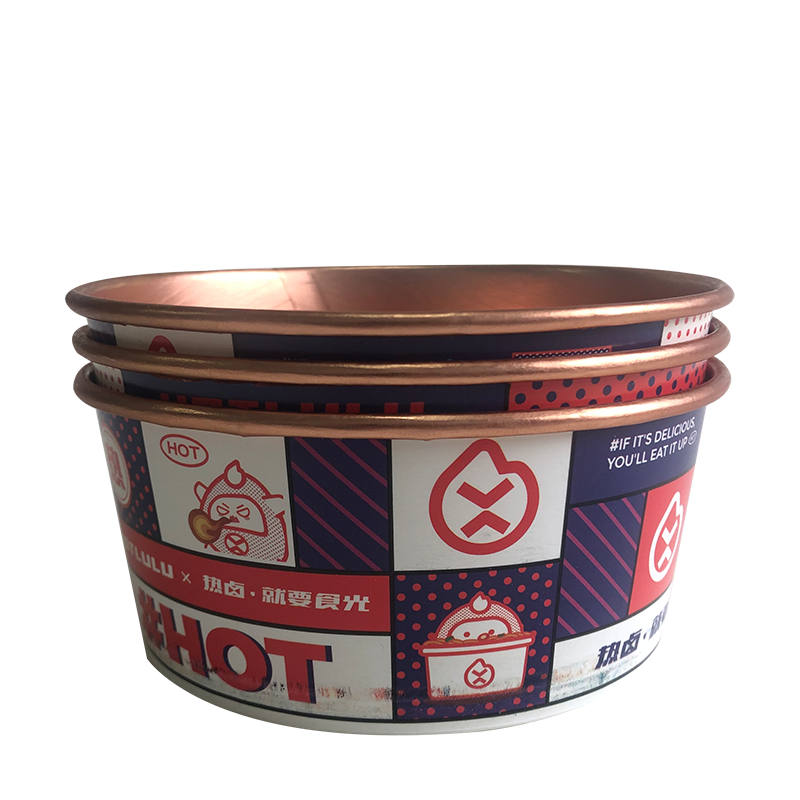
The exterior paperboard surface of aluminum foil paper bowls provides a high-quality print substrate that accepts flexographic and offset printing with excellent color fidelity. The metallic foil visible at the bowl rim and interior creates a premium visual contrast that elevates the perceived quality of printed designs — an effect that is particularly effective for food brands positioned in the premium, artisan, or health-conscious segments.
Several print design considerations are specific to this format:
- Matte exterior with metallic rim contrast — Matte overprint varnish on the exterior combined with the natural foil sheen at the rim and interior creates a visual contrast that is difficult to achieve with any single-material container format. This combination is particularly effective for premium meal kit and retail frozen food branding.
- Oven-safe ink specification — For bowls intended for oven reheating, all exterior inks and varnishes must be specified as oven-safe to the maximum intended temperature. Standard flexographic inks are typically rated to 150–180 °C; high-temperature applications require specifically formulated heat-resistant ink systems.
- Nutritional and regulatory labeling — Retail-format foil paper bowls must accommodate ingredient lists, allergen declarations, and nutritional panels in font sizes compliant with the relevant food labeling regulation (EU Food Information Regulation 1169/2011 or FDA 21 CFR Part 101 for US markets). Bowl geometry and available print area should be confirmed against label content requirements before artwork development begins.
Your email address will not be published. Required fields are marked *
We're Here To Help.

Copyright © HANGZHOU RENMIN ECO-TECH CO.,LTD. All Rights Reserved
Eco Friendly Food Packaging Solution Food Paper Packaging Manufacturer
